Sunday, July 4, 2010

Back to my homeland (part 5)

Days 1-4
Days 5-8
Day 9 - Crowland
Day 9 - Croyland Abbey

Day 9 (continued)

It was quite a day for the Cherringtons, but time was short so we pressed on to Thorney Abbey. We don't have any direct ancestral links to Thorney Abbey but there are connections to Thomas Sutton (1829-1906) and a possible connection to the Cherringtons in a roundabout way.


There were two families in which we were interested.  Baley and Buckworth.  James Usill Baley (son of Susanna Usill Baley and Richard Cherrington Baley)married Elizabeth Sutton, daughter of Thomas Sutton; Frances (Fanny) Buckworth (daughter of Rowland and Mary Buckworth) was the wife of Thomas Sutton (our g-g-grandfather's brother).

Both these marriages took place at Thorney Abbey, so it was reasonable to assume that we would find those surnames in the graveyard, also.

 Sometime ago I found the photograph above here. All due credit and full acknowledgment is given to the photographer for capturing this memorial before its inevitable collapse.  When we arrived, all that was standing was the obelisk, which itself is unmarked, so without this older photograph we would never have known whose burial site it was.

The inscription as recorded on the Churchmouse website is as follows:

East side:
 IN MEMORY OF RICHARD WILLIAM 
THE BELOVED SON OF 
RICHARD CHERRINGTON AND MARY BALEY. 
WHO DIED APRIL 27TH 1885 
IN THE 37TH YEAR OF HIS AGE.
West side:
SACRED TO THE MEMORY 
OF MARY 
THE AFFECTIONATE WIFE 
OF RICHARD CHERRINGTON BALEY. 
WHO DEPARTED THIS LIFE 
MARCH 29TH 1849,
IN THE 36TH YEAR OF HER AGE.

North side:
IN AFFECTIONATE REMEMBRANCE OF 
RICHARD CHERRINGTON BALEY 
WHO DIED MAY 29TH 1888 
IN HIS 76TH YEAR.
South side:-
IN LOVING MEMORY OF 
SUSANNA USILL 
THE SECOND WIFE OF 
RICHARD CHERRINGTON BALEY
WHO DIED SEPT. 26TH 1903 
IN THE 86TH YEAR OF HER AGE.
PEACE, PERFECT PEACE

I'm still working on finding out Richard's Cherrington connection.  If, as I suspect, he was a cousin of our own Elizabeth Cherrington, then his son, James, was a distant cousin of his wife's.

The stones are hard to read, having weathered over two hundred years.

However I was gratified to find the burial place of Thomas Sutton's in-laws, the Buckworths.  Unfortunately the shadow of the trees  made it a bit difficult to read or to photograph clearly.

Here is another member of the Buckworth family.

Inside the abbey it was interesting to find this memorial (not one of ours) on the church floor.
More views of Thorney Abbey.

Yes.  It's a boot-scraper.

Away from the Abbey, I took pleasure in seeing this old round house. I love quirky buildings (so why I live in a rectangular box, I don't know) and this is one of many buildings that caught my eye as we travelled.  Interestingly, across the road was this new house.

I like the way "they" have started building new houses less like identical characterless boxes.  New homes in England are nowadays often more in keeping with their surroundings - at least in historical towns like this one.  (I'm not talking about housing estates and frame houses.) You will notice that to give this house the appearance of being older than it is, it has what look like bricked-in windows.  In 1792, owners of houses with 7-9 windows had to pay a tax of 2/- (two shillings), and those with10-19 windows would pay a tax of 4/- so some people avoided the extra tax by bricking in some of their windows. Many 18th century houses can still be seen with bricked in windows, but this one is a brand-new fake.

Next time we head south, to Sussex.

Saturday, July 3, 2010

Back to my homeland (part 4)

Days 1-4
Days 5-8
Day 9

Day 9 (continued): Croyland Abbey.  The church of Saints Mary Barthlomew and Guthlac adjoins the ruins of the Abbey. The churchyard is filled with stones - some half buried and many weather-worn and faded.

Click on the pictures for a closer look, and use the back button to return to the blog.


Our mission was to find graves of ancestors and to see the place where great-great-great-grandfather, Joseph Sutton married great-great-great-grandmother, Elizabeth Cherrington.  It was also the place where all their children were Christened.

 This is one of many Cherrington gravestones we found, but it was almost as hard to read in real life as it is now.  It might have been easier to take a rubbing of the stone, but we didn't have paper and crayons to do it with.  This one dates to the early 1700s but the date is hard to make out.


These could be the graves of Elizabeth's parents - my great-great-great-great-grandparents.  But they might not be.  Research that far back isn't easy.  Still it's gratifying to know that they lie still undisturbed.


Entering the church the font is the first thing we see. 

The font in the middle of the floor is several hundred years old, and is almost certainly the one used to Baptise Elizabeth and her children. There is an older font set into the wall, which more resembles a well.

The area around the font is well-lit with natural light from clear glass windows.

There is an ornate screen before the altar which has traces of coloured paint on it.


The ceiling above the quire (or choir) has a depiction of the Green Man.  An ancient Pagan symbol of fertility, commonly found in old English churches.

On the wall, a wooden plaque commemorates the passing of a man, his wife and children, and reminds us of our own mortality.  It is dated 1706.


I was excited to find this on the wall near the altar.

"Beneath this stone lieth 
Interr'd the Body of 
Frans Cherrington, 
Relict of 
Willm Cherrington, 
who died August 1:1787 
Aged LX Years.

Reader stay: it is but just
Thou dost not tread on common Dust:
For underneath this Stone doth lye
One whose Name can never die.
Trace her through all the Series of Life,
You'll find her free from Envy, Hate & Strife."

I believe William and Frances Cherrington are Elizabeth's grandparents, which makes them my great-great-great-great-great-grandparents.  (In case you were wondering, we each have one-hundred-and-twenty-eight of them and I have no idea who the remaining one-hundred-and-twenty-six of them are!)

I have a greater appreciation of some of these old churches nowadays.  I've always enjoyed reading monumental inscriptions, but how much more interesting they become when they are for one's own ancestors.

In the next instalment we'll be heading for the south of England.

Friday, July 2, 2010

Back to my homeland (part 3)

Days 1-4
Days 5-8

Day 9: Crowland, Lincolnshire.  This is where it all began, in a way. Our great-great-great-grandfather, Joseph Sutton, came to Crowland at some point and married a young widow called Elizabeth Price.  She was from a long-established Crowland family by the name of Cherrington and had recently inherited a large sum of money from her wealthy uncle.  Joseph Sutton had a business in West Street in which he was variously and sometimes concurrently a grocer, draper and postmaster.

Click on the pictures for a closer look and use the back button to return to the blog.

This is where West Street meets South Street today. Few buildings at the beginning of West Street date as far back as 1840, when we know Joseph had his shop, but there are many other buildings further down the street that do. Since we don't know exactly where his shop was, we can only try to imagine how it looked based on what we can see now.

 The pub on the corner of North Street, bedecked in England flags for the 2010 World Cup, dates back to 1789. It faces Trinity Bridge - originally built to provide a dry crossing over three converging streams but now provides an intriguing focal point in the middle of the road. I can imagine generations of children playing on, under and around it.

This is North Street, as seen from the top of the bridge.


This small Fenland town is quiet, flat and has plenty of wide open space and isn't crowded with people and traffic.


At the South end of the town stands the church of Saints Mary Bartholomew and Guthlac which is built within the ruins of Croyland Abbey.


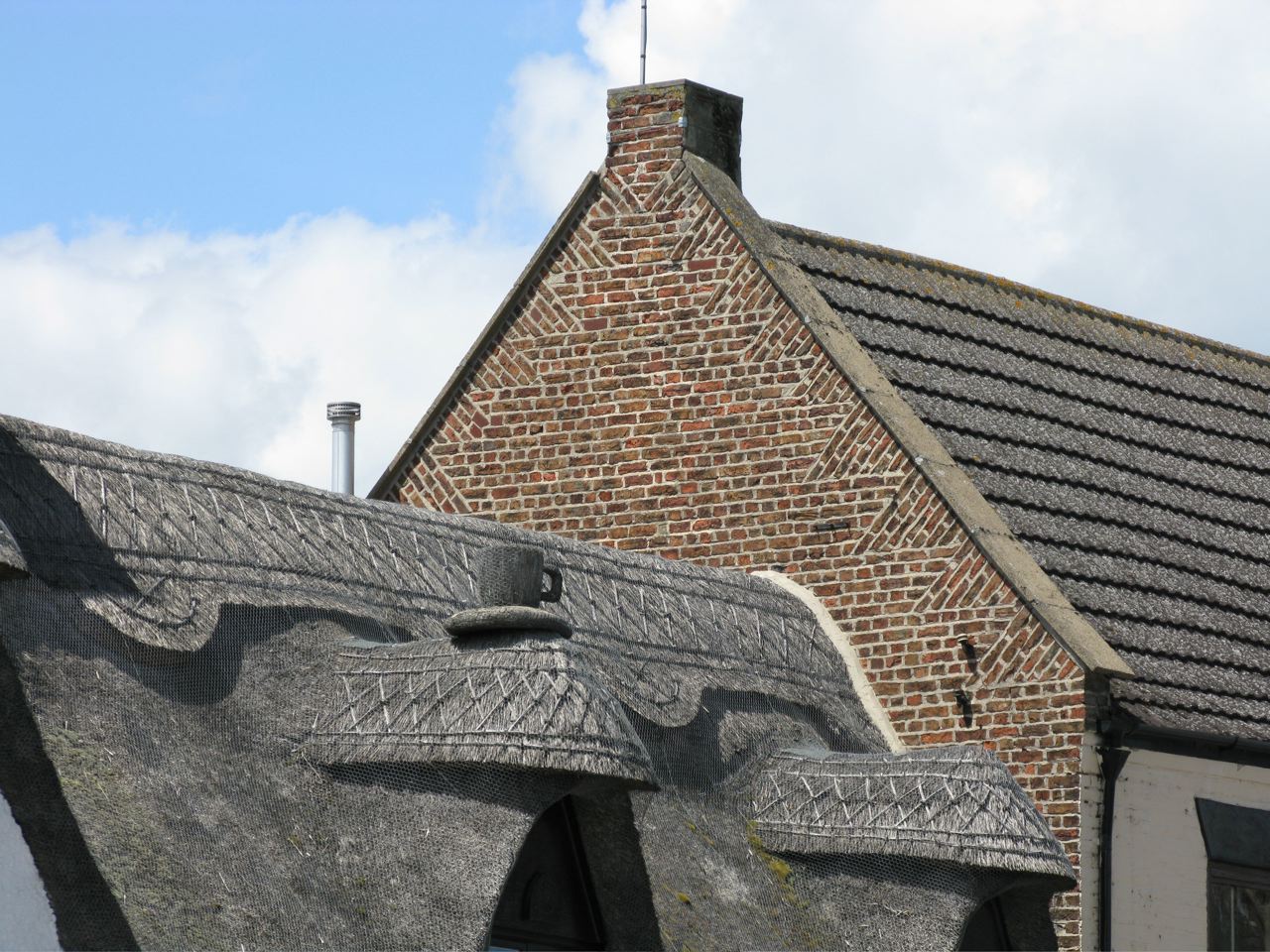
The thatched roof of the Copper Kettle Tea Room with its thatched tea cup abuts another building with ornate brickwork commonly found in houses of the 17th century.

Time for lunch at the Copper Kettle.

This is absolutely the best tea room in England.  Look at that. That was my lunch.  Then look at this:

All the cakes are freshly baked on the premises.  I had a slice of the chocolate and orange cake on the right, but I must say I would have loved to have tasted that lemon cake in the middle.  The tea room is housed in what was a Victorian pharmacy for the doctor who worked next door.

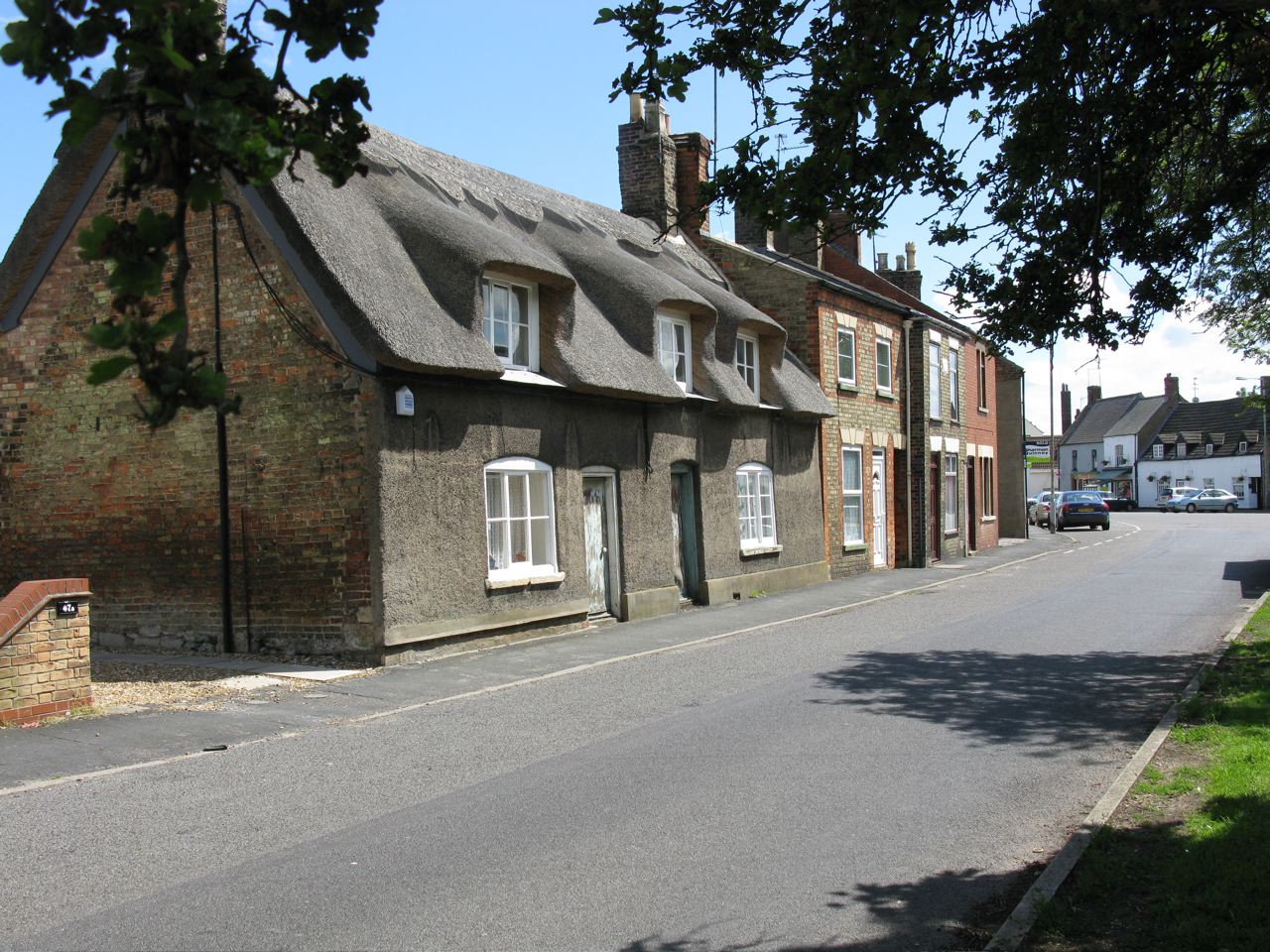
Now for more of Crowland.  The following are all photographs of West Street.


More of Crowland.


Next time, Croyland Abbey.

Thursday, July 1, 2010

Back to my homeland (part 2)

Days 1-4

Day 5: It was a Friday of some driving and some research.  We had lunch at a canalside pub.  How very English.

Click on the pictures for a closer look and use the back button to return to the blog.


Unfortunately I have no idea where we were, but it was quite idyllic.

Most English canals and locks date back at least to the 18th century. (Unless someone knows better.)

After lunch we went to the Northampton Records Office to research our great-great-great grandfather who was from Peterborough, and then we went to our weekend accommodation.  We stayed for the whole weekend at the Axe and Compass, a pub near Leighton Buzzard. (You can Google it if you'd like to see it.)

Day 6: It was unfortunate that we picked a Saturday to visit St. Alban's because it was very busy and there were delays on the roads going into the city.  We managed to do what we set out to do, though.  We drove along Colney Heath Lane where our great-aunt and uncle had lived for many years.  We also visited the town museum where we took our donation of four miniature bottles of Roses cordials (made in St Alban's) and we found the burial place of our third set of great-grandparents.

The grave was unmarked so my sister marked the place herself for the benefit of my camera.  I hope they didn't mind her lying on top of them, but I think great-grandad had a sense of humour...


We returned to the Axe and Compass for dinner and the US v England World Cup game.
That's a heart attack on a polystyrene tray, that is!  Sausage roll, chips and baked beans, all washed down with a glass of Pimms.

Day 7: This was going to be our rest day. We went to Milton Keynes to meet a very old school friend for lunch, and to do a little shopping.  We didn't do much but we did walk around a little bit.  It was nice.  The rest of the day we just meandered around the Buckinghamshire countryside.

Day 8:  On the Monday we left the Axe and Compass and drove to Lincolnshire where me met another old friend in a pub by a shopping outlet near Spalding.  It was a brief meeting but it was lovely to see her again. 


After lunch we made our way to Stamford to see where our great-great grandfather's brothers had gone to school.  It was my first visit to Stamford and as soon as I arrived In knew that a couple of hours weren't going to be enough.  It's on my list of places to visit again for an extended time. 

See what I mean?  Lovely.

More to come another day.